This blog remains online, but it's not being updated anymore.
Instead, further updates are only taking place on my new website AntoniMaroto.com.
See you there!
Thank you,
Antoni Maroto
Showing posts with label Psychology. Show all posts
Showing posts with label Psychology. Show all posts
Wednesday, November 16, 2016

Monday, May 2, 2016
Penrose Steps
The Penrose Steps is a visual illusion that falls in the category of impossible objects, since it cannot be possible in three dimensions.
It is a two-dimensional depiction of a staircase in which the stairs make four 90-degree turns as they ascend or descend, yet form a continuous loop.
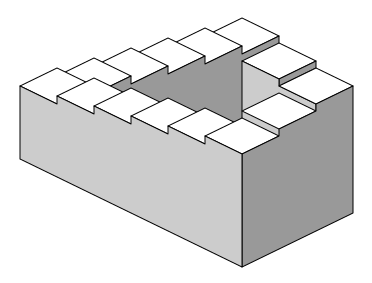
Along with the Kanizsa's Triangle and many more, I have always been a lover of optical illusions and impossible figures; not only because of their beauty, but also due to the interpretations one can make.
For instance, I believe the Penrose Steps represent how people sometimes get stuck in a loop, and fail to realize that one of the corners is closer to the ground, so one could actually jump, be safe and break a pattern.
For instance, I believe the Penrose Steps represent how people sometimes get stuck in a loop, and fail to realize that one of the corners is closer to the ground, so one could actually jump, be safe and break a pattern.
Sunday, October 18, 2015
Trust
You know you cannot make anxiety disappear. You just learn to live with it and have it under control.
You know you are achieving it when:
- You accept it and welcome it into your life. Anxiety is normal. Admitting to it plays a big part in recovery.
- You learn to be comfortable in situations in which you are not in control. The more you demand yourself, the higher your anxiety levels will creep up.
- You are not looking to rely on alcohol/drugs/herbs/medicines/food/other stuff to calm down and worry less.
- You feel you can accomplish things and choose to have positive views on them. Otherwise, anxiety eventually makes the body shut down; that has a name: depression.
My goal is not to eliminate anxiety, but to have it under control so it does not run my life. Some of the strategies I use are: sleep enough, eat healthily, reduce caffeine, exercise and meditate.
Tuesday, July 28, 2015
Find Long-Term Solutions to Prevent Anxiety
This is the third chapter of a series named "Prevent Anxiety".
I recommend you to check the previous episodes in case you missed them:
In order to find long-term solutions to prevent anxiety, the following steps are recommended:
- Learn to live in the present. Embracing every moment and opportunity that comes your way will help you stay grounded in the present. Stop worrying over something in the past or in the future that may cause you harm. Meditating for 10-20 minutes every day can help you focus on your body and your mind. Taking the time to appreciate the sights, smells, and feelings around you is also a way of living the present. Do not take a day of your life for granted: write down all the things you are thankful for and embrace them as much as much as you can.
- Minimize situations that cause anxiety. Avoid as much as you can those situations that cause you anxiety or stress, and make your life easier and more manageable. For instance, if you are always anxious about getting to work late, leave the house fifteen minutes earlier. If you are anxious about how your best friend really feels about you, have an honest conversation with him/her. If going to places where you do not know many people makes you deeply anxious, avoid these situations unless you can find a way to manage them.
- Spend time with calming friends. Seek out the people in your life who make you feel calmer, at ease, and at peace with yourself. Avoid the people who cause worry, make you more stressed, and make you feel like your problems are bigger than they really are. Spend as much time as you can with friends that make you feel grounded.
- Keep a journal. This can help you trace your most anxiety-inducing thoughts and will make you see a pattern to your thinking. Writing a journal is inherently a calming activity, and making time do it every day (15 minutes is recommended) can help you wind down, make sense of your day, and get ready to move forward.
- Learn to accept uncertainty. A big part of anxiety stems from not knowing what is going to happen next. Unfortunately, there is no way you can predict the future. You have to learn to be okay with not knowing what is going to happen next, controlling only what you can control, and learning to take your life one day at a time.
- See a doctor. If you feel that your daily life is filled with overwhelming worry and that nothing you have done has improved the situation, it may be time to see a doctor in order to check if an anxiety-related disorder is present and, therefore, prescribe the corresponding medications or alternative treatments to help you improve.
- Seek therapy. Discussing your every day concerns as well as your larger worries with a professional can make you feel more at ease and less alone. It may also help you gain a new perspective on your worries, and can also make you more comfortable talking about them.
This article is based on this source.
Tuesday, July 7, 2015
Stop Anxious Thinking
One of the best ways to prevent anxiety is to avoid anxious thinking.
The first step is to learn to recognize your anxious thoughts, so you can stop them as soon as possible. Once your heart rate is racing, you start pacing around or tapping your foot, and your thoughts turn to potential disasters, uncertain outcomes, and obsessions over the worst things that can happen. Then, you are in full-on anxiety mode and you need to cut off the problem at the source as soon as possible.
In order to prevent that, you have to develop a routine that helps you fight these thoughts before they are fully formed.
READ: Preventing Anxiety
The second step is to avoid "all or nothing" thinking. This type of thinking happens when you tell yourself that if something does not go perfectly, then you are a complete failure and nothing will ever go right again.
To avoid this kind of thinking, just consider the many possible scenarios that can happen.
The third step is to avoid overgeneralization. Overgeneralizing happens when you draw from one negative experience and think that it has to dictate the rest of your life. Instead, you have to remind yourself that you are drawing from a small set of data and that one bad date or one bad experience will have little impact on your entire life.
In fact, you have to tell yourself that you will have plenty of opportunities for something in your life in the future.
Monday, June 8, 2015
Addicted to Anxiety
Psychiatrist Judith Orloff MD has observed that many people are addicted to the adrenaline rush of anxiety, also known as "the fight or flight response", and do not know how to diffuse it.
On her webpage, she asks us to ask ourselves the following questions:
- Do I worry about many things every day?
- Is it difficult to stop watching anxiety-provoking news on TV or the internet, though I try?
- Do I experience separation anxiety when I can’t access my smartphone or computer?
- Do I make problems larger, not smaller?
- Do I worry about things that no one around me worries about?
- When one anxiety is solved, do I immediately focus on another?
If you answered “yes” to all 6 questions, worry plays a very large, addictive role in your life. 4-5 “yeses” indicates a large role. 2-3 “yeses” indicates a moderate role. 1 “yes” indicates a low level. Zero “yeses” suggests that you’re more warrior than worrier!
She says that in order to quiet anxiety and turn off your fight-or-flight response, it is important to re-train your brain to send chemicals to counteract this powerful biological response. Otherwise, anxiety can become an addiction. In contrast, with calm biology, you can generate endorphins, the blissful natural painkillers in your body.
Monday, May 18, 2015
Preventing Anxiety
Not long ago, I discussed on this blog the difference between fear and anxiety.
Anxiety is a diffuse, unpleasant, vague sense of apprehension. It is often a response to an imprecise or unknown threat.
Here is an example: you are walking down a dark street. You may be feeling a little uneasy and perhaps you are having a few butterflies in your stomach. These sensations are caused by anxiety that is related to the possibility that a stranger may jump out from behind a bush, or approach you in some other way, and harm you.
This anxiety, though, is not the result of a known or specific threat. Rather it comes from one's mind vision of the possible dangers that may result in the situation.
Anxiety is a state over anticipated events, which might not be real, that are perceived as threats.
Today, though, I would like to discuss on how to prevent anxiety.
Sunday, May 3, 2015
Respect Yourself
In times in which you do not seem to achieve what you want, remember to be grateful for what you already have.
Do not concentrate on what you do not have yet: it will make you unhappy.
Instead, take some time to look inside of you and around you; it may not be much, but it is quality that matters.
And last, but not least, remember that you will always have yourself, so you better respect yourself:
Thursday, April 9, 2015
L-I-V-E
Behold all directions: north, south, east and west. And all in between, plus up and down.
Past, present and future. Frontwards, backwards and sideways.
- Walk!
- ...
- I said walk!
- I'm confused, I don't know where to go, I'm scared!
- Of what?
- Of potential dangers.
- You said it well yourself: potential means it could happen, but it may not happen as well.
- Bad things happen.
- Good things happen too, so are you going to spend your time wondering about what bad things could happen to you, or are you going to enjoy the good ones that surely will happen?
- I don't want to be caught by surprise when bad things happen, because you and I know they will. I want to be ready.
- That's just lost energy; and time. Enjoy and trust yourself. You will know how to manage when faced with real danger. And if not, you will learn. So don't be afraid: live and enjoy.
- Ok!
Sunday, April 5, 2015
Defining Fear & Anxiety
Fear and anxiety may produce the same answers to certain dangers; muscle tension, increased heart rate and shortness of breath are some of the symptoms associated with a response to danger.
These changes are believed to be necessary for our survival. In fact, without this stress response, our mind would not receive the alerting danger signal and our bodies would be unable to prepare to flee or stay and battle when faced with danger.
At first, therefore, those symptoms do not have to be necessarily associated with negativity. Survival is, indeed, a very positive thing. Then, we can infer (and we all know already) that giving up surviving is not positive.
The negative side of fear and anxiety comes when they become a permanent fixture in our lives and start controlling our minds (and, consequently, our bodies). They can be interrelated: fear causes anxiety and anxiety causes fear.
But no matter how many similarities they have, those two are not the same thing at all.
Subscribe to:
Posts (Atom)