This blog remains online, but it's not being updated anymore.
Instead, further updates are only taking place on my new website AntoniMaroto.com.
See you there!
Thank you,
Antoni Maroto
Showing posts with label Science. Show all posts
Showing posts with label Science. Show all posts
Wednesday, November 16, 2016

Monday, May 2, 2016
Penrose Steps
The Penrose Steps is a visual illusion that falls in the category of impossible objects, since it cannot be possible in three dimensions.
It is a two-dimensional depiction of a staircase in which the stairs make four 90-degree turns as they ascend or descend, yet form a continuous loop.
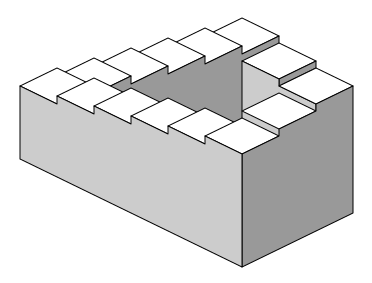
Along with the Kanizsa's Triangle and many more, I have always been a lover of optical illusions and impossible figures; not only because of their beauty, but also due to the interpretations one can make.
For instance, I believe the Penrose Steps represent how people sometimes get stuck in a loop, and fail to realize that one of the corners is closer to the ground, so one could actually jump, be safe and break a pattern.
For instance, I believe the Penrose Steps represent how people sometimes get stuck in a loop, and fail to realize that one of the corners is closer to the ground, so one could actually jump, be safe and break a pattern.
Thursday, July 23, 2015
Agave Americana
One of the plants that I believe is among the most beautiful is Agave americana, also known as century plant, maguey, or American aloe. It is a species of plant that is native to Mexico, Arizona, and Texas. In addition, it has become naturalized in the West Indies, parts of South America, the Mediterranean Basin, and parts of Africa, India, China, Korea, Thailand, New Zealand, and Australia. The American aloe denomination is actually a misnomer since the plant is not related to the genus Aloe.
Agave americana usually lives between 10 and 30 years. Towards the end of its life, the plant grows up a tall, branched stalk, which may reach a total height up to 25-30 feet (8-9 meters). The upper part of the stalk contains yellow blossoms.
The plant dies after flowering, but it produces shoots from the base, which continue its growth.
If the flower stem is cut without flowering, a sweet liquid called aguamiel (Spanish for "honey water") gathers in the heart of the plant. This may be fermented to produce the drink called pulque. The leaves also yield fibers, which are suitable for making rope, matting, coarse cloth and are used for embroidery of leather in a technique known as piteado.
In the tequila-producing regions of Mexico, agaves are called mezcales. The high-alcohol product of agave distillation is called mezcal; Agave americana is one of several agaves used for distillation. There is a mezcal called tequila, which is produced from Agave tequilana.
Sunday, July 5, 2015
Great-Circle Distance
One of the things that we learn at school when we study geometry is that the shortest distance between two points is always a straight line. That is true in plane geometry. But if we are talking about a sphere, that statement is not correct.
The first time I went to the United States, my curiosity led me to search for maps showing the routes that airplanes follow and the surprise was huge: airplanes do not follow straight lines!
I could not understand the reason why airlines would want to make flights longer and spend more on fuel.
Thus, I learned that representing the Earth on plain surfaces as maps entails some distortions. For instance, the Mercator projection, used by Google Maps, shows us Greenland being almost as big as Africa when in reality the latter is like 14 times bigger than the former. Likewise, in this type of projection, Alaska and Brazil seem to have a similar size, even though Brazil is five times bigger than Alaska.
Therefore, thinking automatically of a straight line that unites two airports is actually a mistake. Indeed, the shortest line on a sphere will always be the one that draws the greatest circle between two points. That circle is also known as an orthodromic line. Nonetheless, it is not always possible for airplanes to follow this pattern since there are zones that are restricted to civilian air traffic. Meteorological conditions or volcanic activity may also affect an air route.
Saturday, June 20, 2015
June Solstice
Today, it takes place the June Solstice, which is the Summer Solstice in the Northern Hemisphere, and in the Southern Hemisphere is the Winter Solstice.
A solstice (from Latin solstitium, meaning "sun-stopping") happens when the sun's zenith is at its furthest point from the equator.
On the June solstice, the sun reaches its northernmost point at about 23.5ºN. In addition, the Earth’s North Pole tilts directly towards the sun. It is also known as the northern solstice because it occurs when the sun is directly over the Tropic of Cancer in the Northern Hemisphere.
On this day, the midnight sun is visible throughout the night, in all areas from just south of the Arctic Circle to the North Pole. Meanwhile, on the other side of the planet, south of the Antarctic Circle there is the polar night: no sunlight at all, on the June Solstice.
Here (Barcelona, Catalonia), the sun is rising at 6:18 am and setting at 9:28 pm, thus making the duration of the day 15 hours and 10 minutes. It is, indeed, the longest day of the year.
However, the earliest sunrise already took place at 6:17 am on June 12th-18th, while the latest sunset will take place at 9:29 pm on June 23rd-July 1st.
What is the reason for this?
Sunday, May 31, 2015
Midnight Sun
In the Northern Hemisphere, June has the shortest nights of the year.
Besides, the area south of the Arctic Circle to the North Pole has permanent daylight during most of this month; when at least part of the Sun's disk is visible above the horizon 24 hours of the day, we call it the midnight sun.
This event is visible at the Arctic Circle from approximately June 12th until July 1st. The number of days per year with potential midnight sun increases the farther one goes towards the North Pole. This place gets, indeed, the midnight sun for half year, since there is only one sunrise and one sunset by the time around the equinox.
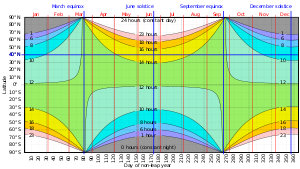
During June too, many areas south of the Arctic Circle experience the white nights: there is light all night, but the sun disk is not visible for the full 24 hours.
Likewise, places from latitudes between 48.5ºN and 60ºN do not experience total darkness, since twilight continues all night. And the higher the latitude, the lighter the sky.
Tuesday, May 19, 2015
Wind Chill
Understanding the concept of wind chill has been one of the most fascinating things I have ever learned in my life.
Wind chill is the apparent temperature felt on exposed skin because of the wind. That is, the temperature that our bodies might feel can be different from the actual air temperature.
The human body temperature is approximately 37ºC (98.6ºF). Since the air around is usually below that temperature, we are losing heat from anywhere not covered by clothing. When the air is still, we are mostly losing heat by convection.
However, when a breeze hits the face, the initial loss is from conduction: the wind cools the temperature of the skin almost to air temperature. Convection plays a part as well, helping to dissipate the warm air from the face. If the skin is wet, there will be additional cooling from the evaporation of moisture.
The stronger the wind, the faster the cooling. The lower the temperature, the more impact the wind has. Indeed, you can experience it yourself:
- Blow the back of your hand: it will feel cooler.
- Now, lick the back of your hand and blow: it will feel colder.
- If you increase the speed of blowing, it will feel even colder.
This article contains information from this source.
Saturday, May 9, 2015
Pomegranate
Lately, I have been finding myself craving pomegranate juice. Some of you will raise your eyebrows and say: "How does he dare? He is almost always drinking it."
Well, that is not a lie, but what I actually miss is the real homemade juice, and not the one you can easily buy at the store. Indeed, that one usually comes mixed with apple juice; and I am sorry, but the flavor is not the same.
My friends, we have to wait until September. That marks the beginning of the season - it lasts until February - in which we will have pomegranates available in any grocery in the Northern Hemisphere.

For those who are not familiar, as you can observe above, the pomegranate (whose botanical name is Punica granatum) is a berry, the size of between a lemon and a grapefruit, 5–12 cm in diameter with a rounded shape and thick, reddish skin.
The name pomegranate derives from Latin pōmum "apple" and grānātum "seeded".
The number of seeds in a pomegranate can vary from 200 to 1400 seeds, even though some of us will assert that there are exactly 613. In fact, I will talk about that when we are closer to Rosh Hashanah.
Monday, April 20, 2015
Kanizsa's Triangle
The Kanizsa's Triangle is a visual illusion that falls in the category of illusory contours. These evoke the perception of an edge without a luminance or color change across that edge, like on the next image:

Here, these spatially separate fragments give the impression of a bright white triangle, defined by a sharp illusory contour, occluding three black circles and a black-outlined triangle.
UPDATE (04/28/2016):
Actually, I never mentioned that the reason why I like this figure is because it resembles the Star of David. However, since I have spoken about Judaism several times through this blog, that should not come as a surprise to you.
Sunday, April 19, 2015
False Sunset
Yesterday, I had the chance to witness an event called false sunset.
This event can refer to any of the following atmospheric optical phenomena:
1) the sun appears to be setting below the horizon, while in reality it is still some distance above it
2) the sun has already set, but still appears to be on or above the horizon.
There are several atmospheric conditions which may cause the effect, most commonly a type of halo, caused by the reflection and refraction of sunlight by small ice crystals in the atmosphere, often in the form of cirrus or cirrostratus clouds.
Sunday, April 12, 2015
Sun
The last beams of light are way beyond the horizon, but an optical illusion makes us think they are still there. Indeed, they are saying goodbye and goodnight.
Darkness starts growing behind and soon will cover the whole sky. From blue to black.
Another day is behind, but a new one expands.
First twilight, then night.
I am not worried, as within some few hours, the sun will be back.
Since day number four, it has not ever missed an appointment; do not forget that...
Subscribe to:
Posts (Atom)